

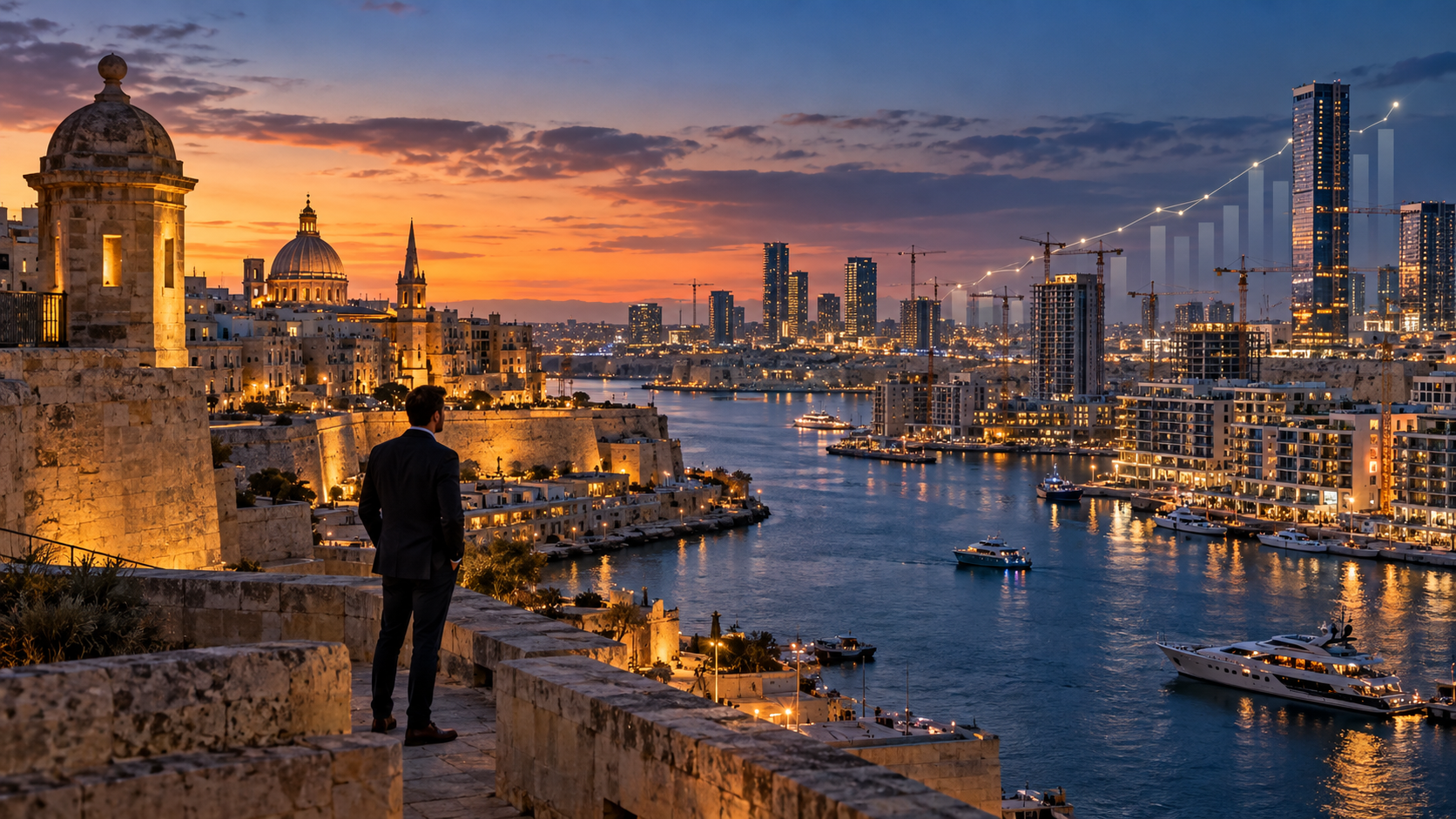
Malta’s economy is growing at a pace much of Europe would envy. But GDP alone cannot tell us who is benefiting, where the money is flowing, or whether today’s boom is building lasting prosperity. JP Fabri looks beyond the headline numbers to ask whether wages, productivity, housing, investment and public services are keeping pace with the country’s economic success.

JP is a founding partner at Seed, a multidisciplinary advisory practice.
Malta is booming. The latest national accounts confirm an economy that continues to expand at a pace many in Europe would envy. Services remain the overwhelming engine of growth, employment remains strong and nominal GDP reached €6.5 billion in the second quarter of 2026. There is no need to diminish this achievement. Malta has spent the past decade building a larger, more diversified and more internationally connected economy, and the results are visible in the macroeconomic numbers.
But GDP answers a very particular question: how much economic activity is being generated? It does not tell us how that prosperity is being distributed, whether household living standards are improving at the same pace, or whether today’s growth is strengthening the foundations for tomorrow’s prosperity. Increasingly, those are the more interesting questions. Malta may be booming, but are workers booming? Are businesses becoming more productive? Is capital financing the next generation of companies? Is government converting a larger economy into better infrastructure and public services? Or is a disproportionate part of the wealth created by growth ultimately being capitalised into the price of scarce assets, particularly land and property?
One way into this debate is to follow the money. The latest GDP figures are actually encouraging from the perspective of workers. Compensation of employees contributed around 4.1 percentage points to nominal GDP growth in the second quarter of 2026, compared with around 2.2 points from gross operating surplus and mixed income. This is not the picture of an economy in which businesses are simply capturing all the gains while workers are left behind. Wages are rising, and labour income is currently contributing substantially to economic growth.
Yet one quarter does not erase a much longer structural trend. Central Bank analysis shows that Malta’s adjusted labour income share declined by 11.7 percentage points between 1995 and 2023. Malta’s labour share has also remained below the euro-area average, with the gap becoming particularly pronounced since the early 2010s. Most interestingly, the decline cannot be explained simply by Malta moving into sectors where labour traditionally captures less value. The changing composition of the economy would, by itself, actually have increased the labour share by around 1.5 percentage points. Instead, 7.9 percentage points of the decline came from falling labour shares within sectors themselves.
That distinction matters because it complicates the familiar prescription that Malta simply needs to attract more “high-value” industries. We certainly need sophisticated sectors, but the presence of a high-value industry does not automatically create high-value work throughout an economy. Information and communication, financial services and professional activities were among the sectors that became increasingly important while simultaneously experiencing declining labour shares. A country can therefore become more sophisticated on paper without the gains from that transformation necessarily flowing proportionately towards labour.
This does not mean that a falling labour share is inherently bad. The Central Bank makes this point well. If businesses invest heavily in technology and capital, productivity can rise enough for workers to enjoy higher real incomes even while labour receives a smaller share of a much larger economic pie. The distributional question therefore cannot be separated from the productivity question. Indeed, this is where the current wage increase creates both an opportunity and a warning for Malta.
We should want wages to rise. Competing through cheap labour is not an economic strategy appropriate for an advanced European economy. But wages ultimately need productivity to support them. If a worker costs 5% more but produces 5% or more additional value, the economy can absorb the increase. If labour costs repeatedly rise faster than output per worker, unit labour costs rise and competitiveness eventually suffers. Businesses must either accept lower margins, raise prices, reduce employment, invest to improve productivity or lose competitiveness internationally. No sustainable economic model lets wages permanently outrun productivity.
This is why the current debate about who benefits from growth should not deteriorate into the familiar argument between workers and businesses. Their long-term interests are more closely aligned than that framing suggests. Malta’s objective should be a high-wage, high-productivity economy, not a choice between higher wages and competitive firms. Countries that can sustain high salaries are generally those where workers use better technology, have stronger skills, have more capital, have better management, and have more efficient infrastructure. The real competitiveness question for Malta is therefore not whether labour is becoming too expensive. It is whether our productive capacity is improving quickly enough to support the wages we increasingly expect.
Here the structure of Malta’s growth model becomes important. For much of the past decade, expanding output could be achieved relatively easily by expanding inputs. More workers could be recruited, more tourists attracted, more buildings constructed and more consumption generated.
Migration played an essential role in allowing businesses to expand when domestic labour supply became insufficient. But an economy that can easily add another worker faces less immediate pressure to reorganise production around technology, automation and productivity. As the earlier analysis noted, if labour is readily available and relatively inexpensive, hiring another person can be economically more attractive than undertaking the more difficult process of redesigning a business.
That decision is not irrational. Firms respond to incentives. The same applies to capital. If property provides attractive, relatively predictable returns, supported by scarce land, a growing population, tourism demand, and a financial system comfortable with property-backed lending, investors will rationally allocate capital toward it. The deeper question is what these individually rational decisions produce collectively.
This brings property directly into the distribution of Malta’s prosperity. Growth does not disappear when it fails to appear in wages. Some flows into company profits, some into taxation and government expenditure, some is reinvested, and some becomes capitalised into assets. In a country where land is exceptionally scarce, economic and population growth naturally increase demand for property. Those who already own land and property can therefore participate in economic growth not only through their income but through appreciation in their wealth. Those attempting to acquire those assets for the first time experience the same mechanism in reverse.
This creates an important divide that conventional GDP statistics struggle to capture. Two households may live in precisely the same booming economy and experience it completely differently. An established household with property, investments and rising income can benefit simultaneously from wage growth and asset appreciation. A younger household dependent almost entirely on wages may receive a salary increase while watching a significant part of that gain absorbed by rent, mortgage costs and other necessities. GDP records the expanding economy. It does not tell us whether access to the assets generated by that economy is becoming easier or harder.
The role of government should not escape scrutiny. A larger economy produces greater fiscal capacity, but government also represents an increasingly important part of economic activity. In the second quarter, government consumption contributed 2.5 percentage points to real GDP growth, compared with 1.7 points from private consumption and around 1 point from fixed investment. One quarter should never be treated as a structural trend. Still, it raises the same question that should apply everywhere else: what are we getting for the additional resources being deployed?
If public expenditure creates better transport, education, healthcare, digital infrastructure and more efficient institutions, it raises the productive capacity of the entire economy. If infrastructure fails to keep pace with economic expansion, growth loses some of its prosperity to congestion, delays, unreliable systems, and declining quality of life. The distinction matters because public-sector productivity ultimately affects private-sector competitiveness too. A worker sitting in traffic, a company waiting on a permit or a business absorbing infrastructure inefficiencies all carry costs that do not necessarily appear in the wage bill but affect the economy’s ability to compete.
The question “who is winning?” therefore has no simple answer. Workers are currently experiencing stronger income growth, and that should be recognised. Businesses have benefited from an expanding domestic economy and access to a much larger labour pool. Government has benefited from the fiscal resources associated with economic expansion. Asset owners have benefited from the appreciation generated by scarcity and rising demand. Malta’s economic model has created genuine prosperity across several channels.
But it has not distributed the gains equally, nor could any economic model realistically do so. The more important question is whether the mechanisms through which prosperity spreads are strengthening or weakening. The Central Bank’s long-run labour-share figures suggest that this deserves serious attention. At the same time, rising labour costs make productivity increasingly urgent, while housing and asset prices determine how much of rising nominal income translates into improved living standards.
This is why Malta’s next economic transition cannot simply be about finding another sector, importing another cohort of workers or generating another few percentage points of GDP. It must increasingly be about higher-value work. That means workers equipped with better skills, businesses investing in technology and management, finance flowing towards productive enterprise, firms scaling through capability rather than simply headcount, and infrastructure that reduces rather than adds friction. Education, migration, innovation, banking, property, productivity and wages are not separate economic debates. They form one system.
Malta’s first great transformation was about scale. We became remarkably good at growing the economy. The next must be about depth: how much value each worker creates, where capital flows, how productivity gains are shared and how much prosperity remains after housing and the other costs of participating in a booming economy are paid.
The question is therefore no longer whether Malta is booming. It plainly is. The more revealing question is whether the economic model lets enough people convert that boom into lasting prosperity. And increasingly, the answer will depend not simply on how fast wages rise, but on whether productivity rises with them, whether capital finances productive activity rather than merely scarce assets, and whether growth creates opportunities to accumulate wealth rather than simply making existing wealth more valuable.
Malta is booming. The challenge now is to make sure more of Malta can genuinely say the same.














Malta’s economy is expanding rapidly, but headline GDP figures only tell part of the story. JP Fabri examines wages, productivity, property, investment and public spending to ask whether the country’s economic boom is translating into lasting prosperity for enough people.