

Where we live, how we live
Drawing on new findings from Malta's National Housing Satisfaction Survey, Matthew Zerafa and Brian Micallef examine the relationship between residential satisfaction, community environments, and quality of life.
Residential satisfaction and life satisfaction are closely interconnected, as housing constitutes one of the central domains of everyday life. Residential satisfaction generally refers to the extent to which individuals feel content with their dwelling, neighbourhood, and surrounding environment. In contrast, life satisfaction reflects a broader assessment of the overall quality of life and well-being.
The relationship between the two is often explained by the understanding that the home is not merely a physical structure, but also a social, psychological, and emotional space. Individuals who are satisfied with their housing conditions tend to experience greater comfort, security, privacy, and stability, all of which contribute positively to overall well-being and happiness. Conversely, dissatisfaction with housing, including overcrowding, poor building quality, lack of affordability, noise, insecurity, or inadequate services, can generate stress and adversely affect mental and emotional health.
To better understand the key factors shaping residential satisfaction in Malta, the Housing Authority conducted a nationally representative survey involving around 800 respondents aged 18 and over residing in Malta. Crucially, both Maltese and non-Maltese nationals were covered in this survey. The survey explored a wide range of themes, including respondents’ demographic profiles, life satisfaction, housing conditions, and neighbourhood characteristics. It combined objective indicators, such as tenure, living arrangements, and features available within the property, with subjective ones, such as satisfaction levels, adequacy of space, and perceptions of housing cost burden. This study forms part of the Housing Authority’s Research Strategy for 2026–2027, which places evidence-based research at the centre of housing policy development in Malta.
We adopted a broad perspective on residential satisfaction, recognising that the concept extends beyond the dwelling itself to encompass the surrounding neighbourhood and, for those residing in apartments, the common areas within the block. The latter is becoming increasingly significant, particularly since around 40% of respondents reported living in apartments. There is also evidence that block sizes have been increasing over time.
Respondents were asked to rate their level of satisfaction with three dimensions — the dwelling, the neighbourhood, and the block — on a scale from 1 to 5, where 5 represented the highest level of satisfaction and 1 the lowest.
Satisfaction with the dwelling recorded the highest average score at 4.3 out of 5, followed by neighbourhood satisfaction at 4.1 and block satisfaction at 3.9. Hence, satisfaction tends to be higher in areas where individuals exercise greater direct control, while it declines in domains that depend more heavily on collective management or external environmental factors.
Consistent with the international literature, we document a positive correlation between residential satisfaction and life satisfaction (see the chart). This underscores the importance of incorporating both housing and neighbourhood satisfaction into broader measures and indices of well-being.
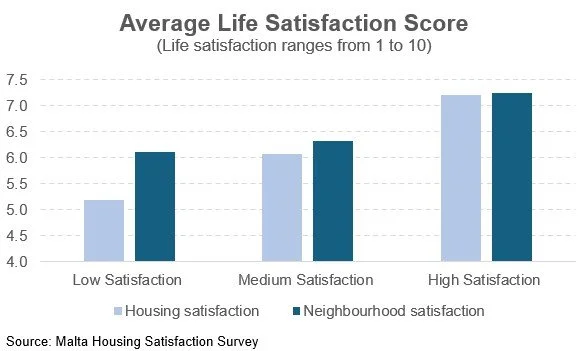
What Malta's National Housing Satisfaction Survey reveals about the connection between our homes, our communities, and our well-being.
The survey further explored the principal problems identified by respondents in their dwellings, blocks, and neighbourhoods. Regarding the dwelling itself, the most frequently reported issue was the lack of a garage or parking space, reported by around one-third of respondents. This was followed by the absence of outdoor areas, mentioned by approximately one-quarter of respondents, and accessibility-related concerns, such as excessive stairs.
Interestingly, dwelling-related concerns varied significantly by age and citizenship status. Younger adults and migrants were considerably more likely to report parking difficulties than elderly respondents, reflecting differences in housing typologies: the former tend to reside predominantly in apartments. At the same time, older individuals are more likely to live in houses. Similarly, younger adults and migrants were more likely to report concerns about the lack of outdoor space, housing quality, or insufficient living space. In contrast, elderly respondents more frequently reported accessibility challenges and having more space than they actually require.
Among respondents residing in apartments, the principal concerns relating to the block centred on accessibility issues, including, in some cases, the absence of lifts, as well as problems associated with permanent residents. Poor condominium maintenance and difficulties with other tenants, in both long-let and short-let properties, were each mentioned by around two in ten respondents.
At the neighbourhood level, the lack of parking spaces again emerged as the most significant issue raised by respondents. Approximately 7 out of 10 respondents identified parking as a problem in their neighbourhood. These pressures are likely to intensify over time, particularly given the rise in apartment living alongside persistently high car ownership. Other commonly reported neighbourhood concerns included construction-related disturbances, excessive noise pollution, and the lack of green and open spaces, each of which was mentioned by approximately four to five out of every ten respondents. These findings are broadly consistent with results from other surveys, including the EU-SILC.
Another noteworthy finding is that, unlike dwelling-related concerns, which varied across demographic groups, perceptions of neighbourhood problems were remarkably consistent across respondent categories. The relative consistency in neighbourhood concerns suggests a need for broader, system-wide interventions to improve the quality and sustainability of the living environment. It also highlights the importance of approaching housing not in isolation, but as an integral component of a broader urban system.
From a policy perspective, improving housing quality and neighbourhood environments is increasingly recognised as a key element in promoting public well-being. Urban planning, affordable housing policies, improved access to services, and community development initiatives can therefore contribute not only to better residential outcomes but also to higher levels of life satisfaction across the population.
Matthew Zerafa is the CEO of the Housing Authority, and Brian Micallef is the Executive Head responsible for the Digitalisation, Legal, and Communications departments at the Housing Authority.
















As Malta's property market matures, Zanzi's Steve and Michael Mercieca discuss technology, trust, governance and why the next decade will favour disciplined operators over growth-at-all-costs ambition.