

Evicted by risk, buried by bills

Dr Vincent Micallef
As Malta strengthens construction regulations, a quieter question remains unresolved: who supports families when precautionary evacuations force them from their homes? Lea Hogg speaks with Dr Vincent Micallef about the financial, legal and social gaps that emerge between displacement and recovery.
In Malta's tightly packed urban landscape, construction risk is a lived reality. On 14 May 2026, ten families in Naxxar were evacuated after structural instability linked to nearby development works triggered a precautionary response. A stop-work order followed swiftly, and residents were temporarily relocated as engineers moved in to stabilise the site and assess safety for reoccupation.
Dr Vincent Micallef, a lawyer and governance adviser who heads a Valletta-based legal and advisory firm, argues that the real disruption begins after the evacuation: "There is a particular silence that follows an evacuation order. It is the silence of a family that has been told that the place where they live is no longer safe for them to be in."
Evacuations are often measured in hours, while inspections and engineering reports are measured in days. Far less attention is paid to the days and weeks that follow, when households are left to navigate the practical and financial consequences of displacement. Rather than exploring catastrophic failure, our discussion with Dr Vincent Micallef focused on what happens in the intervening period between evacuation and recovery and who bears the costs. At the same time, institutions, insurers and legal processes gradually catch up.
Immediate cost of displacement
Evacuation creates a financial split that is rarely visible in policy design. On the one hand, there is the physical cost of relocation: hotel stays, temporary accommodation, transport, and food. In the recent evacuation in Naxxar, developers covered hotel costs directly.
There is also a slower accumulation of losses that fall outside standard insurance categories. Dr Micallef lists them plainly: "Replacement school transport. The food that has to be discarded from the freezer. The medication that is left in the bathroom cabinet."
Viewed individually, these losses appear trivial. Taken together, they reveal a category of disruption that falls largely outside the protection offered by conventional insurance. As Dr Micallef notes, they are precisely the kinds of expenses that "no insurance policy is designed to indemnify". The financial burden accumulates quietly, not through a single catastrophic cost, but through dozens of small, immediate expenditures that arrive just as a household's sense of stability is removed.
Mortgage repayments continue to fall due. Utility contracts remain in force. Direct debits are collected as normal, and credit histories remain exposed to missed payments.
Three instruments of protection – and their limits
Maltese construction risk, as Dr Vincent Micallef outlines, rests on three principal instruments: compulsory third-party liability insurance (with a minimum threshold of €750,000 under Legal Notice 38 of 2024), bank guarantees embedded in construction regulations, and the long-tail liability carried by architects and contractors under Article 1638 of the Civil Code.
Each mechanism serves a distinct function, yet none is designed to address the consequences of displacement fully. Insurance, in particular, establishes a regulatory floor rather than a comprehensive shield. As Micallef observes, that floor is increasingly misaligned with Malta's urban property values, noting that "the floor begins to look like a number selected for short-term expediency rather than for actuarial fit".
More fundamentally, the system is structured to respond to physical damage and personal injury, not the secondary effects of being removed from one's home. Loss of use, temporary accommodation, and the wider disruption to daily life are either excluded or tightly constrained. At the same time, even where coverage exists, claims processes tend to move slowly, leaving households exposed for months before any form of resolution materialises.
One evacuated Naxxar family described waiting in the dark about whether their deposit-backed guarantees would ever be meaningfully triggered, highlighting how limited the instrument feels on the ground. As Dr Micallef puts it, "The guarantee is best understood as a procedural retention rather than as a fund out of which damages are paid." This limits its value as a source of recovery for affected households, which cannot reasonably rely on it to bridge the financial gap created by displacement.
The third instrument, long-tail liability under Article 1638 of the Civil Code, imposes a 15-year liability on architects and contractors for structural defects and, on paper, is one of the stronger elements of Malta's framework. However, it is also the most delayed in its effect. Liability must first be established, causation demonstrated, and in many cases, court proceedings concluded before any compensation is realised.
For displaced families, this creates a clear mismatch between legal entitlement and lived reality, where formal rights exist long before practical relief becomes available.
Mortgage obligation without pause
The mortgage dimension reveals one of the most significant gaps in the system, particularly in situations of displacement: obligation without pause. A home may become uninhabitable, but the loan secured against it remains fully active, with no standard mechanism for suspending repayments in cases of displacement. Any relief is typically discretionary, offered by banks on a case-by-case basis rather than through a structured framework.
As Dr Micallef notes, the underlying logic is, in principle, defensible: "The underlying assumption is simple: if a building becomes uninhabitable, that is a risk the borrower should have insured against."
Yet no widely available insurance product effectively covers this exposure comprehensively or in a structured way. The result is what he describes as a second-order market failure, in which the risk is real and material but not properly priced into any functioning market instrument. The consequence is that households absorb the shock directly, with credit exposure increasing precisely when income stability is undermined.
ESG and the gap between liability and relief
Between evacuation and resolution, households enter a procedural gap in which no single system is fully operative. Liability has not yet been formally established, insurance claims remain unprocessed, and technical assessments are still ongoing. Each mechanism advances on its own timetable, independent of the immediate needs created by displacement.
One resident displaced in Naxxar described it more bluntly: "You are told everything is being handled, but nothing actually reaches you." While arbitration mechanisms exist in certain circumstances, their pace remains slow compared with the urgent needs of affected households.
At its core, the issue is one of timing. Legal and regulatory systems are primarily designed to determine fault and assign responsibility, not to provide immediate liquidity for day-to-day living costs in the aftermath of displacement.
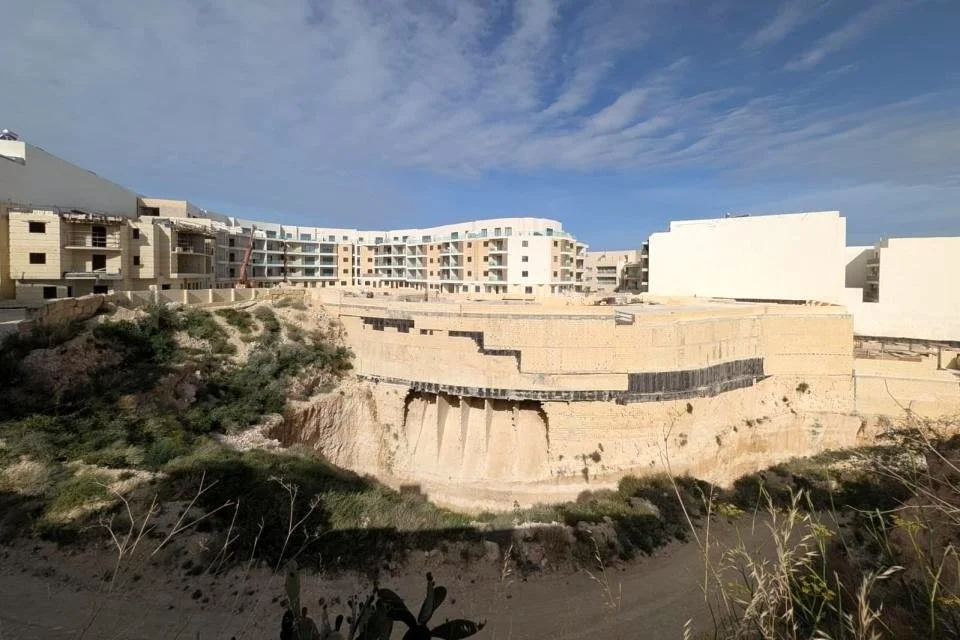
Photo Chris Sant Fournier
A key argument emerging from the analysis is that Malta's construction sector has made clear progress in technical regulation, yet remains comparatively underdeveloped in its social framework. Since the 2019 reforms, environmental standards and governance structures have become more defined, with clearer licensing regimes, waste management rules and oversight mechanisms.
The more uncomfortable gap sits in the "S" of ESG, which remains the least enforceable and most discretionary pillar. While environmental and governance pillars are increasingly formalised, the social dimension, particularly the way communities are supported during periods of disruption, remains largely informal and inconsistently applied.
As Dr Micallef puts it, "A sector's 'social licence' to operate is not granted by its legal compliance. It is granted by its capacity to demonstrate… that the human costs of its activity are absorbed by the enterprise that generates them."
However, support for displaced households continues to depend heavily on individual developers rather than on any standardised, sector-wide obligation. Some respond swiftly and generously; others do only what is strictly required. The absence of a uniform protocol leaves outcomes uneven and unpredictable at times.
Architecture of practical reform
Dr Vincent Micallef does not frame Malta's construction risk framework as a system in need of total reinvention. The argument, as he sets it out, is more restrained and arguably more difficult: that the existing architecture already contains the necessary instruments. Still, they are increasingly misaligned with the realities they are meant to manage.
At the centre of this recalibration is insurance. The current €750,000 minimum for compulsory third-party cover, he suggests, is steadily losing relevance in a market where property values have moved significantly ahead of regulatory thresholds. The issue is not simply adequacy at a point in time, but drift. As Micallef puts it, "A frozen minimum is, over time, a vanishing minimum." His proposal is straightforward: tie the threshold to a property price index so that it evolves with market conditions rather than lagging behind them.
A second strand of reform concerns what he describes as the social infrastructure of construction risk. Here, the argument moves beyond compensation into process and expectation. The idea of a Social Resilience Protocol is less about creating new liabilities and more about standardising behaviour during displacement.
This would mean that affected households are not left to navigate uncertainty on an ad hoc basis, but instead benefit from a predictable framework: guaranteed accommodation support, clear points of contact, defined timelines for technical reporting, and reimbursement of incidental costs. Crucially, this would not be framed as an additional legal obligation but as a sector-wide standard. The emphasis, he argues, is not charity but predictability.
The third intervention sits at the intersection of housing finance and risk. At present, mortgage obligations and insurance responses operate largely in parallel, even when they address the same underlying event. Micallef's view is that this separation is increasingly difficult to justify in cases of certified displacement.
A more coherent approach, he suggests, would combine insurance riders specifically designed to cover displacement-related costs with automatic mortgage payment deferrals triggered when a property is formally deemed uninhabitable. Neither element requires new primary legislation; both depend instead on alignment between banks and insurers.
The final element of the framework shifts attention upstream, to the point at which risk is first assessed rather than where it is ultimately absorbed. A recurring weakness in the system, he notes, is the inconsistency in geological assessment prior to construction, particularly on more complex sites. The proposal here is to make robust geological reporting a condition of financing, effectively requiring lenders to enforce higher standards before releasing capital. In doing so, risk management is moved closer to the origin of the problem, rather than left to resolve itself after damage has occurred.
Taken together, these proposals reflect a broader view of how accountability evolves. A quieter but significant development, he observes, is the gradual strengthening of professional licensing standards for masons and contractors
As these baseline requirements rise, they begin to influence not only practice but also the pricing of risk itself, feeding into insurance assessments and legal expectations. As Micallef notes, "A documented standard of competence becomes the baseline against which the courts measure prudent practice."
What is emerging is less a neat feedback loop than a slow and uneven redistribution of risk, already underway but largely outside formal acknowledgement.
Human layer beyond regulation and finance
Beyond regulation and finance, the analysis repeatedly returns to a more elemental point: displacement carries a human cost that policy instruments struggle to fully capture. The frameworks governing construction risk in Malta are largely designed around liability, compensation and technical resolution. Yet the lived reality of evacuation sits outside those categories, unfolding in ways that are slower, messier and more difficult to formalise.
Families are left to navigate uncertainty for extended periods, often returning to sites that remain partially unsafe or unresolved, and to manage repeated updates without clear timelines for resolution. The result is not a single moment of disruption, but a prolonged state of instability in which normal life routines are repeatedly interrupted and never fully re-established.
The impact is unevenly distributed. Older residents, in particular, experience displacement not as a logistical inconvenience but as a significant disruption to daily life, mobility and wellbeing. What may be temporary friction for some households becomes, for others, a sustained period of dependency and stress.
CLOSING THE GAP
Practical reforms proposed by Dr Vincent Micallef
✓ Index insurance thresholds to property values: Review compulsory third-party insurance regularly to ensure the minimum cover keeps pace with Malta's rising property prices.
✓ Introduce a Social Resilience Protocol: Establish a standard framework for supporting displaced households, including accommodation, communication and reimbursement procedures.
✓ Create displacement-specific insurance products: Develop policies that cover the indirect costs of evacuation, including temporary accommodation, transport, and essential household expenses.
✓ Allow automatic mortgage payment deferrals: Trigger temporary repayment relief when a property is officially declared uninhabitable.
✓ Improve coordination between banks and insurers: Ensure affected residents receive practical support without having to navigate multiple disconnected systems.
✓ Strengthen geological assessments before construction begins: Require robust site investigations as part of the financing and approval process for higher-risk developments.
✓ Shift risk management upstream: Focus more attention on prevention and mitigation before excavation starts, rather than relying solely on post-incident remedies.
✓ Continue raising professional standards: Enhance licensing, competency requirements and oversight for contractors and construction professionals.
These effects sit largely outside the scope of insurance coverage and formal regulatory design, yet they are central to how such events are experienced. Over time, they also shape something less tangible but equally significant: public confidence in the construction sector and the institutions that manage its risks.
Alignment in Malta's construction risk
The Naxxar incident did not expose a collapse of Malta's construction framework. Emergency response was swift, regulatory action was immediate, and developers engaged with affected households in the aftermath. On the surface, the system functioned as designed.
Yet the more revealing issue is not outright failure, but the uncomfortable reality that perfectly functioning systems can still produce collectively dysfunctional outcomes. Insurance frameworks are calibrated to respond to damage, not the lived reality of displacement. Mortgage structures assume continuity of repayment rather than interruption of habitation. Legal liability mechanisms are designed to establish fault and reach a resolution, not to provide timely interim relief.
In that gap between design intent and lived experience, a different kind of vulnerability emerges, less visible than structural failure, but persistent in its effects. It is here that the system's strengths and limitations sit side by side.
As Dr Vincent Micallef concludes, the question is no longer whether the architecture exists, but whether it is properly scaled to the risks it now governs: "That architecture has been substantially rebuilt since 2019. Whether it is yet sufficient is a question that readers are particularly well placed to answer."
The gap, in other words, is not dramatic in the sense of collapse. It is structural in the sense of design. And in construction risk, as this case illustrates, structural gaps matter most precisely when nothing has fully failed, but everything has already been altered.















As Malta's property market matures, Zanzi's Steve and Michael Mercieca discuss technology, trust, governance and why the next decade will favour disciplined operators over growth-at-all-costs ambition.