

Malta is digital-ish, but not yet smart

Malta has built the foundations of a digital nation. The next challenge is connecting its systems, data and services so the country can become genuinely smart
Malta has embraced digital transformation, but digitising services is only the beginning. JP Fabri argues that the country's next challenge is not to become more digital, but to become genuinely smarter. He explores what it will take to build a nation where technology solves real-world problems rather than simply moving paperwork online.
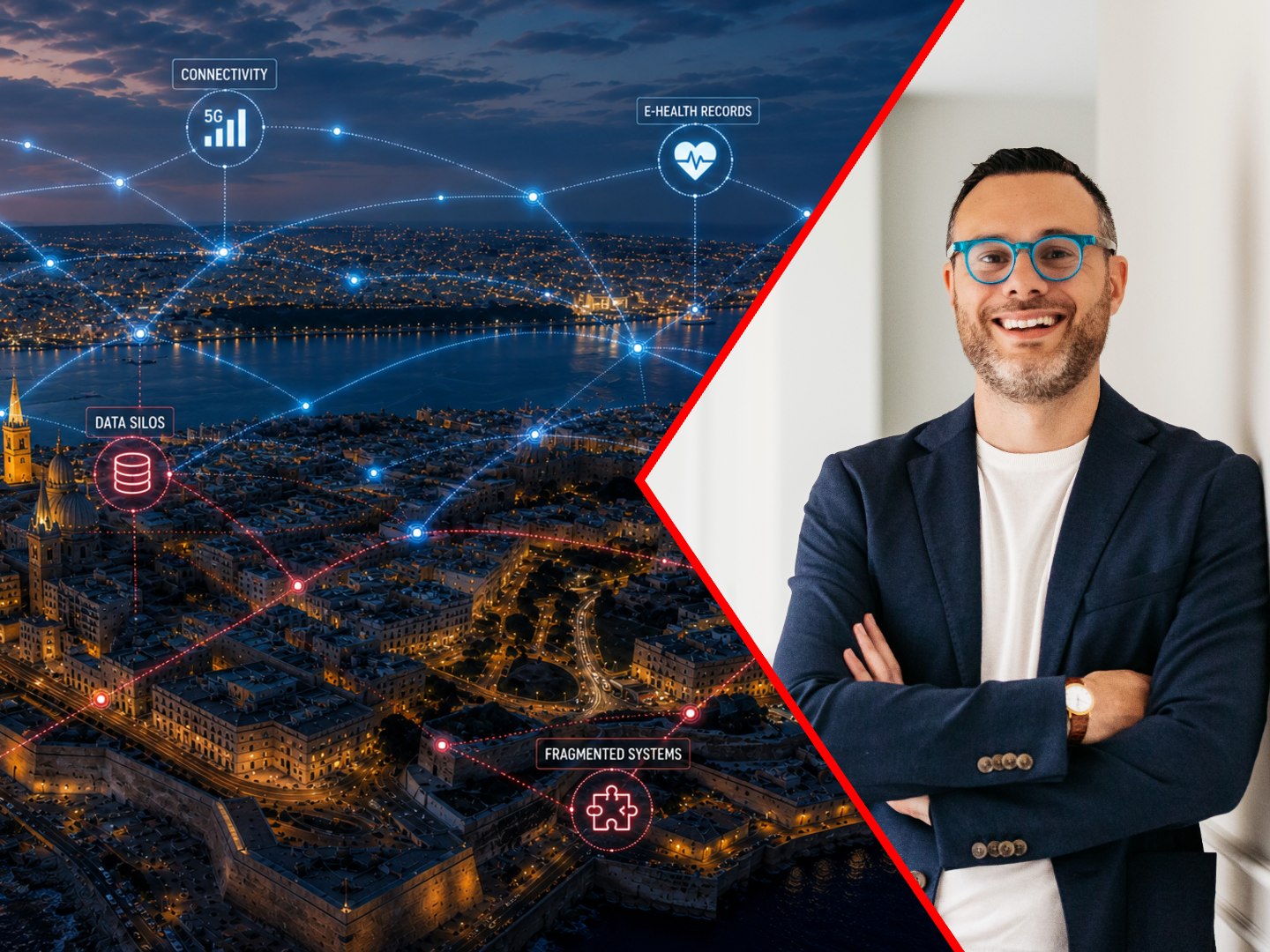
Malta has become very good at looking digital. On the main indicators, the country performs well. We have full, very high-capacity network coverage, full basic 5G coverage, very strong digital public services for citizens and businesses, and a business community that is increasingly adopting digital tools. Even access to electronic health records is improving, while enterprise uptake of artificial intelligence is above the European average. These are not small achievements. They reflect years of investment, regulatory focus and administrative reform. Yet the real question is no longer whether Malta is digital. The more important question is whether Malta is becoming smart.
There is a difference between a digital country and a smart nation. A digital country puts services online. A smart nation changes the way a country senses, decides and acts. A digital country has portals. A smart nation has systems that speak to each other. A digital country allows people to submit forms electronically. A smart nation designs life around people and businesses so that the form almost disappears. This is where Malta's challenge lies. We have built many digital doors, but too often they still open into separate rooms. We have digitalised processes, but we have not yet reimagined the country's operating system.
This is why Malta feels digital-ish. The experience is partly modern and partly fragmented. A person may authenticate online, submit a document, receive a confirmation and still have to chase a department because the next part of the process sits somewhere else. A business may deal with one agency digitally, but then repeat similar information to another. A patient may know that digital health records exist, yet still feel that access to health information, referrals, test results, prescriptions and private provider data is not seamless enough. Citizens do not judge digitalisation by indicators. They judge it by whether life becomes simpler, faster and less frustrating.
The next stage of Malta's transformation must be understood in layers. The first layer is infrastructure. This is where Malta has done well. Connectivity matters because it is the foundation on which everything else rests. Without broadband, mobile networks, cloud capacity and secure systems, there can be no serious digital economy or digital public service. But infrastructure is only the bottom layer. It is like building roads and then assuming mobility has been solved. Roads matter, but mobility depends on how traffic flows, how junctions are managed, how buses are routed, how parking is priced, how schools and workplaces shape peak demand, and how data allows the system to learn.
The second layer is identity, consent and trust. A smart nation needs a trusted digital identity that becomes part of daily life, not only a key for government portals. It should allow a citizen to prove who they are, sign documents, access health records, open accounts, interact with insurers, apply for support, and deal with regulated services securely and simply. This should not mean that the state sees everything or that citizens lose control of their data. It should mean that people can give consent once, share verified data safely, and know who accessed what, when and why.
The Malta Business Wallet is therefore a step in the right direction. Still, it should be seen as the beginning of a much larger transformation rather than as a narrow repository for business documents. Its real potential is not simply that a company can hold documents digitally. Its real potential is that Malta can begin to build a trusted credential layer for the economy. A business should eventually be able to hold and share verified credentials relating to its registration, directors, beneficial ownership, tax status, licences, permits, compliance standing, ESG disclosures, insurance cover and eligibility for schemes. These credentials should not need to be repeatedly uploaded, certified, stamped and re-submitted. They should be issued once by a trusted source, held securely, shared with consent, and verified instantly by another authorised party.
The same logic should apply to individuals. The future should not be built around scanned documents sitting in different portals. It should be built around personal and corporate credentials that are trusted, portable and machine-verifiable. A citizen should be able to prove identity, residence, qualifications, professional authorisations, driving entitlement, health eligibility or other key attributes without giving away more information than is needed. A company should be able to prove that it is licensed, compliant or eligible without going through another round of paperwork. This is where digital identity becomes economic infrastructure. It reduces friction, lowers compliance costs, strengthens trust, and creates the conditions for both the public and private sectors to build services on top of a common digital foundation.
The third layer is data flow. This is where the smart nation begins. Malta produces enormous amounts of data every day through transport, telecoms, waste, health, schools, planning, enforcement, tax, local councils and private firms. The problem is that too much of this data sits in silos. It is collected for one purpose, stored in one system, governed by one entity, and rarely converted into collective intelligence. A smart Malta would treat data as a national asset, protected carefully, shared responsibly and used to improve decisions. Institutions should not hoard data as a sign of control. It should flow across the system under clear rules, strong safeguards and a shared national purpose.
Take traffic. Malta does not need another debate about whether congestion exists. It needs a real-time mobility intelligence layer that combines bus movements, ferry usage, parking data, school transport patterns, roadworks, delivery logistics, weather, events and anonymised movement trends. This would allow the country to manage flows rather than simply react to jams. Bus routes could be tested before being changed, roadworks sequenced according to network impact, and parking policy linked to demand rather than politics. The point is not to create a surveillance state, but to build a transport system that learns.
The same logic applies to waste. We often discuss waste as a cultural problem, which it partly is, but it is also a systems problem. A smart waste layer would connect collection routes, bin capacity, commercial waste patterns, tourism zones, construction activity, enforcement records and recycling performance. It would show where the system is failing, where collection needs to change, where abuse is recurring, and where incentives should be redesigned. In a small island with limited land, waste cannot remain a routine municipal function. It has to become a live management system.
Compliance is another area where digitalisation can change the state's capacity. Malta's enforcement model is still too dependent on complaints, inspections and visible crises. A smarter compliance architecture would connect planning permits, business licences, employment registrations, VAT activity, environmental obligations and sector-specific rules in a risk-based system. This would reduce the burden on those who do things properly while identifying anomalies earlier. The best digital state is not one that asks for more paperwork. It uses the data it already has to distinguish between risk, error and abuse.
Healthcare may be the most important test of whether Malta can move from digital services to smart systems. Digital health should not simply mean that records are available somewhere online. It should mean that the patient journey becomes integrated. A citizen should be able to access key records, book services, receive reminders, manage prescriptions, understand test results, share information with trusted providers and move between public and private care without the system losing memory. For doctors and policymakers, better data should support prevention, not just treatment. A health system that remembers, predicts and guides is very different from one that only records.
The best small-state examples show that success is not built around one app or one portal, but around a national digital stack of identity, payments, verified data, secure exchange, common standards and services designed around life events and business journeys. The lesson for Malta is that the next stage cannot be only about putting more services online. It must be about creating a trusted layer where personal and corporate data can be verified, shared with consent and reused safely across the whole ecosystem. A family does not experience government as ministries. A business does not experience regulation as departments. People experience the state as a journey. The smarter the country, the more invisible the bureaucracy becomes.
For Malta, this requires a different governance model. Digital transformation cannot remain scattered across agencies, projects and procurement cycles. It needs national architecture: common data standards, clear rules for data sharing, privacy by design, cyber resilience, secure APIs and a much stronger culture of interoperability. We also need mission teams that bring policy, operations and technology together around national problems such as congestion, waste, health access, skills, planning, tourism pressure and compliance. Technology teams should not be brought in after policy has already been designed. They should be part of the design from the start.
This also means being honest about capabilities. Malta has a shortage of ICT specialists, and too many citizens still lack strong digital skills. A smart nation cannot be built only by consultants, suppliers and a small group of technical officials. It needs public officers who understand data, regulators who understand technology, teachers who can prepare students for a digital world, and citizens who are confident enough to participate. Inclusion is not charity. It is a condition for adoption. Otherwise, the country will become digitally advanced in statistics but unequal in practice.
The opportunity is enormous because Malta is small enough to act as a genuine living laboratory. We can connect systems faster than larger countries, test new models in defined localities, scale what works and stop what does not. We can build a national mobility dashboard, a live waste intelligence platform, a consent-based health data layer, a single business journey for permits and support, and a digital ID ecosystem that works across public and private services. None of this requires science fiction. It requires discipline, architecture and political will.
Malta should be proud of its digital progress, but pride must not become complacency. The next national ambition should not be to score well on indicators. It should be to make the country work better. Digitalisation was the first stage. Smartness is the next. The country now needs to move from portals to platforms, from documents to credentials, from transactions to journeys, from data collection to data flow, and from digital projects to national intelligence. That is how Malta can become more productive, more liveable and more resilient, not by becoming digital for its own sake, but by becoming smart enough to solve the problems that people and businesses feel every day.









As AI optimises more of our lives, Adrian Galea argues that lived experience, taste, judgement and human connection could become our most valuable competitive advantages.