

The algorithmic shift: Navigating the EU AI Act and the new era of product compliance
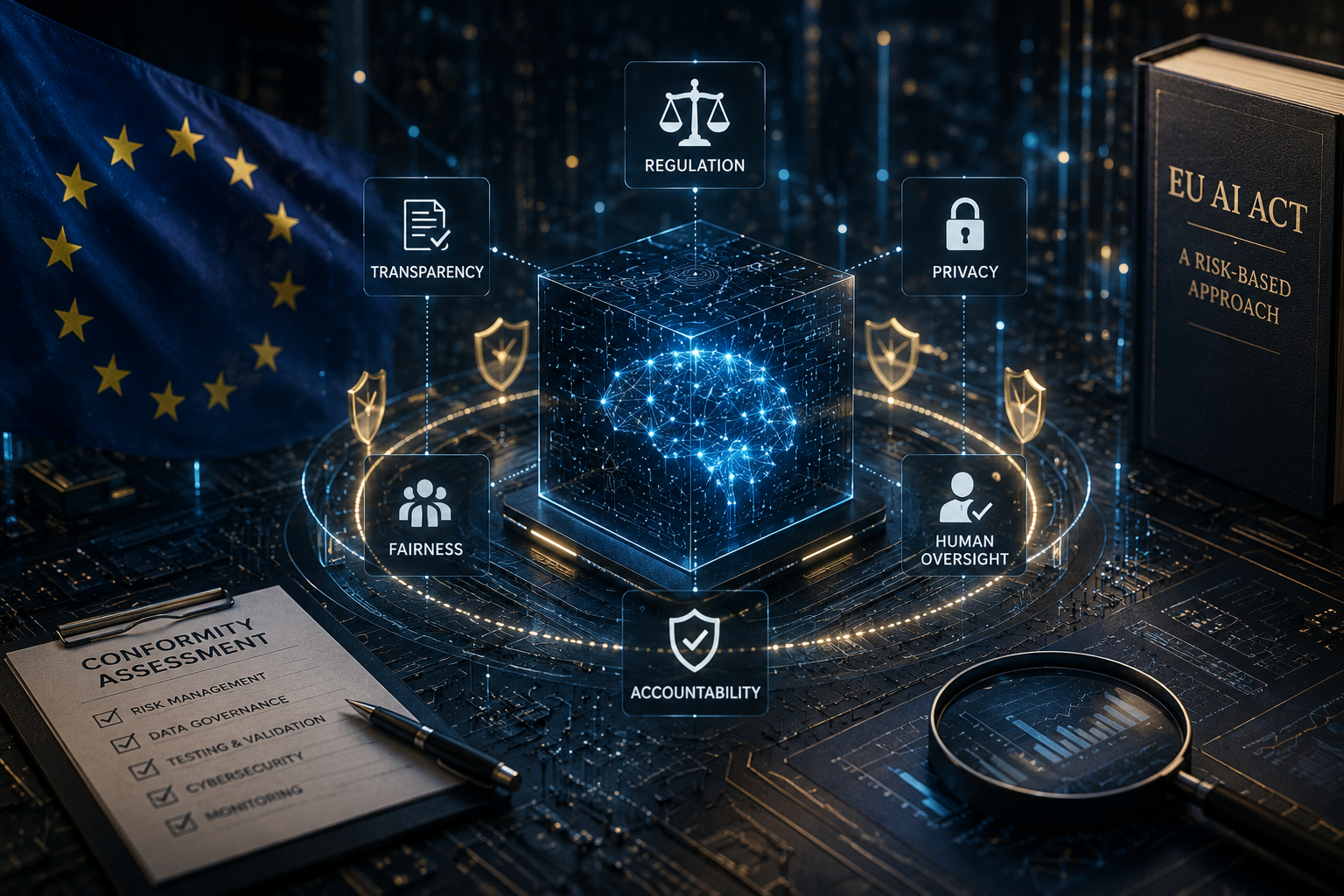
AI is transforming business, but innovation is no longer enough. Stephen Mallia explores how the EU AI Act is reshaping product compliance, forcing organisations to rethink how they design, govern, and trust intelligent systems in an increasingly regulated digital economy.
Artificial intelligence has become the defining technology of the decade. Across Europe, businesses have raced to integrate AI into products, services and everyday operations, driven by one overriding fear: being left behind.
But as the excitement settles, a new reality is emerging. Success is no longer measured simply by how quickly organisations adopt AI, but by how safely, transparently and responsibly they use it.
The European Union's Artificial Intelligence Act marks a turning point. For the first time, AI systems are being regulated using many of the same principles that have governed physical products for decades. Businesses can no longer treat AI as an experimental technology operating in a legal grey area. AI is becoming another product that must be demonstrably safe, reliable and fit for purpose.
For executives, engineers and compliance professionals, this represents one of the biggest regulatory shifts since the introduction of the New Legislative Framework (NLF). More importantly, it signals a broader mindset shift. Building AI is no longer enough. Companies must now prove that it can be trusted.
Moving beyond the hype
Much of the debate surrounding artificial intelligence has been dominated by extremes. Some portray it as a miracle technology that can solve every business problem, while others warn it will replace human intelligence altogether.
Neither view reflects reality. AI is best understood as a powerful statistical tool. It identifies patterns, predicts outcomes and automates decisions based on data. Its greatest value lies in improving efficiency, supporting better decision-making and solving complex problems at scale.
The real question is no longer whether AI works. It is whether organisations can demonstrate that it works safely, fairly and consistently.
That challenge sits at the heart of the EU AI Act. Unlike conventional software, many AI systems continue to evolve. Their behaviour depends on the quality of the data they receive, the assumptions built into their models and, in some cases, continuous retraining after deployment. This makes them fundamentally different from the products that existing European legislation was designed to regulate.
For decades, manufacturers have worked within a predictable regulatory framework. Machinery, electrical equipment and electronic products are expected to behave consistently. Given the same conditions, they should always produce the same outcome.
AI doesn't always follow those rules. An AI-powered industrial robot, autonomous vehicle or recruitment platform makes decisions based on probabilities rather than fixed logic. As new data becomes available, its behaviour can change, introducing levels of uncertainty that traditional product legislation was never designed to address.
That is precisely why the AI Act adopts a fundamentally different approach. Rather than regulating every AI application equally, it takes a risk-based approach, with obligations increasing according to the potential impact on people and society.
The EU AI Act risk pyramid
Unacceptable risk: Banned applications such as social scoring and cognitive manipulation.
High risk: Systems used in critical infrastructure, healthcare, employment, education and AI-powered machinery. These require strict conformity assessments and ongoing compliance.
Limited risk: Applications such as chatbots and AI-generated content that must meet transparency requirements.
Minimal risk: Low-impact systems such as spam filters and AI-powered games, which face few regulatory obligations.
A different way of thinking about compliance
Traditional European product legislation is designed to protect people from physical harm. A power supply either meets electrical safety requirements or it doesn't. A machine either emits acceptable electromagnetic interference or fails laboratory testing. Compliance is based on measurable engineering principles and repeatable outcomes.
The AI Act broadens that definition of safety. While protecting health and physical wellbeing remains essential, the legislation also introduces concepts rarely associated with product compliance, including fairness, transparency, privacy and fundamental rights.
Consider two examples. If an industrial pump overheats or exposes an operator to dangerous voltages, it clearly fails existing safety legislation.
Now imagine an AI system used to approve mortgages or prioritise healthcare treatment. Even if it performs exactly as designed, it may still breach the AI Act if its decisions consistently disadvantage particular demographic groups or rely on biased data.
Compliance is therefore no longer just about preventing physical injury. It is also about preventing harmful outcomes created through automated decision-making.
For businesses developing AI, this represents a significant cultural shift. Software quality can no longer be measured solely by uptime, speed or reliability. Organisations must also demonstrate that their systems are transparent, explainable and governed responsibly throughout their lifecycle.
The technical file is evolving
Every compliance engineer understands the importance of the technical file. It provides the evidence that a product has been designed, tested and assessed against the relevant legislation.
Traditionally, this documentation includes engineering drawings, electrical schematics, bills of materials and laboratory test reports.
The AI Act significantly expands that documentation. Instead of recording only physical components, organisations must now document how AI systems are designed, trained, tested and controlled.
That includes the model architecture, the datasets used during development, the methods employed to identify and reduce bias, the assumptions made during training and the safeguards that allow humans to intervene when necessary.
In many respects, data becomes another engineering component. Just as manufacturers verify the quality of steel, electronic components or structural materials, they must now demonstrate the quality of the data used to train their AI models.
Regulators increasingly want answers to fundamental questions. Where did the data come from? How was it selected? Does it accurately reflect the environment in which the AI system will operate? Could hidden bias influence its decisions?
These are no longer academic considerations. Under the AI Act, they become essential elements of regulatory compliance. Technical documentation must therefore extend well beyond hardware specifications to include governance processes, model performance, human oversight and data quality.
For many organisations, this will require a fundamental rethink of how they create and maintain compliance documentation.
Testing never really ends
Traditional product testing is largely deterministic. An electrical device is tested against recognised standards and, as long as the hardware remains unchanged, the results remain valid.
AI behaves differently. Because many AI models continue to evolve, compliance becomes an ongoing process rather than a one-off event.
Manufacturers of high-risk AI systems must demonstrate not only accuracy, but also robustness, cybersecurity and resilience against failure. They must continue monitoring system performance after deployment and update documentation whenever retraining alters behaviour or introduces new risks.
The emphasis shifts from static certification to continuous assurance. That may sound like an administrative burden, but it reflects the reality of intelligent software. If AI continues learning after release, compliance cannot end the day the product enters the market.
Cybersecurity is now product safety
As businesses become increasingly connected, compliance can no longer be separated from cybersecurity. The AI Act sits alongside a growing body of European legislation, including NIS2 and the Cyber Resilience Act (CRA). Together, they signal a shift away from reacting to cyber incidents and towards building resilience into products from the outset.
This matters because AI is no longer confined to software running in the cloud. It is increasingly embedded in industrial machinery, medical devices, autonomous systems and critical infrastructure. A cyberattack on one of these systems is no longer just an IT incident. It can quickly become a real-world safety risk.
Traditional cybersecurity focuses on protecting databases, securing networks and encrypting communications. Those priorities remain essential, but AI introduces an entirely new generation of threats.
These include data poisoning, where attackers manipulate training data; adversarial attacks, where subtle changes trick AI systems into making dangerous decisions; and model extraction, where criminals attempt to reconstruct sensitive data or steal the AI model itself.
Managing these risks requires more than conventional cybersecurity controls. Organisations need governance processes that identify vulnerabilities early, test AI systems under hostile conditions and document how those risks are mitigated throughout the product lifecycle.
Traceability becomes essential
One of the most significant changes introduced by the AI Act is its emphasis on traceability. Traditional software logs typically record errors or performance issues. High-risk AI systems must go much further.
Organisations need reliable audit trails showing how decisions were made, what data was used, the confidence level of each output and whether a human operator intervened.
This transparency allows organisations to investigate incidents, demonstrate compliance and understand why an AI system reached a particular conclusion. More importantly, it creates accountability. As AI assumes greater responsibility in healthcare, manufacturing and financial services, organisations must explain how decisions are made rather than hiding behind a technological "black box".
AI's sustainability paradox
AI promises to make industry cleaner, smarter and more efficient. Yet it also comes with a growing environmental footprint of its own. Used effectively, AI can optimise supply chains, improve energy efficiency, predict equipment failures before they occur and reduce waste across manufacturing and logistics. Predictive maintenance alone can extend the life of expensive industrial assets while significantly reducing energy consumption.
Imagine an industrial HVAC system. Instead of operating on fixed schedules, AI can continuously analyse occupancy, weather conditions and equipment performance, adjusting energy use in real time. Similar gains can be achieved across factories, transport networks and utilities.
Yet training large AI models requires enormous computing power, consuming significant amounts of electricity and water to cool data centres. Recognising this challenge, the AI Act encourages greater transparency around the energy consumption and environmental impact of large-scale AI models.
For business leaders, sustainability must therefore extend beyond what AI enables to how AI itself is developed. That means choosing efficient models over unnecessarily complex ones, using renewable-powered cloud infrastructure where possible and designing hardware that can be upgraded rather than discarded.
Responsible AI is not simply about building smarter systems. It is about ensuring those systems deliver a genuine net benefit for business, society and the environment.
One integrated compliance framework
At first glance, the AI Act may seem like another layer of bureaucracy in an already complex regulatory landscape. In reality, it has been designed to work alongside Europe's existing product safety framework rather than replace it.
An AI-powered industrial robot, for example, may need to comply with both the Machinery Regulation and the AI Act. Rather than creating separate approval processes, the legislation allows these assessments to be integrated into a single conformity assessment.
The practical outcome is straightforward. Instead of maintaining separate engineering and AI documentation, organisations should develop unified technical files that combine hardware specifications, software architecture, cybersecurity controls, risk assessments, human oversight, and data governance.
This integrated approach not only simplifies compliance but also encourages engineers, software developers, cybersecurity specialists and compliance teams to collaborate from the earliest stages of product development.
Compliance as a competitive advantage
When major regulations arrive, businesses often see them as another obstacle to innovation. History suggests otherwise. Companies that embrace high standards consistently become the most trusted organisations in their industries. Strong governance, transparent processes and robust engineering build confidence among customers, investors and regulators alike.
View the AI Act through the same lens. Rather than slowing innovation, it provides the foundation for responsible innovation. Organisations that can demonstrate trustworthy AI will be better placed to win contracts, enter regulated markets and build lasting customer confidence.
For decades, product compliance largely focused on proving that machines were safe. The AI Act expands that responsibility to intelligent systems, requiring organisations to demonstrate not only how products perform, but how they make decisions, how they are monitored and how they protect the people who rely on them.
Businesses that view compliance purely as another regulatory hurdle will always be playing catch-up. Those that embrace it as part of good engineering and responsible innovation will be better placed to earn trust, compete internationally and build products that stand the test of time.
The AI race is no longer just about building smarter systems. It's about building systems that deserve trust.















As AI optimises more of our lives, Adrian Galea argues that lived experience, taste, judgement and human connection could become our most valuable competitive advantages.